Article-Journal

Nanobody modified high-performance AIE photosensitizer nanoparticles for precise photodynamic oral cancer therapy of patient-derived tumor xenograft
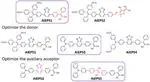
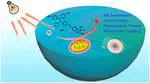
Photodynamic therapy (PDT) is a promising noninvasive treatment option for patients suffering from superficial tumors, such as oral cancer. However, for photosensitizers (PSs), it remains a grand challenge to simultaneously excel in all the key performance indicators including effective singlet oxygen (1O2) generation under clinical laser, specific targeting function and stable far-red (FR)/near-infrared (NIR) emission with low dark toxicity. In addition, traditional PS nanoparticles (NPs) for clinical use suffer from quenched fluorescence and reduced 1O2 production caused by molecular aggregation. To address these issues, AIEPS5 with aggregation-induced FR/NIR emission and effective 1O2 generation under 532 nm laser irradiation is designed by precise optimization of the chemical structure. By attaching a polyethylene glycol (PEG) chain onto AIEPS5, the yielded amphiphilic AIEPS5-PEG2000 can spontaneously self-assemble into water dispersible NPs, which are further endowed with targeted delivery function via the decoration of anti-Her-2 nanobody (NB). The bespoke AIEPS5-NPs-NB exhibit effective 1O2 generation capability, bright FR/NIR emission centered at 680 nm, and negligible dark toxicity, which outperform Heimbofen, a clinically approved PS in PDT using a patient-derived tumor xenograft model.
Nanobody modified high-performance AIE photosensitizer nanoparticles for precise photodynamic oral cancer therapy of patient-derived tumor xenograft
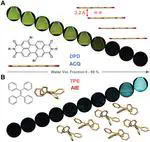
All-in-One Molecular Aggregation-Induced Emission Theranostics: Fluorescence Image Guided and Mitochondria Targeted Chemo- and Photodynamic Cancer Cell Ablation
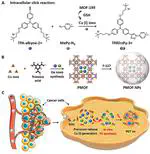
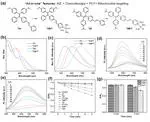
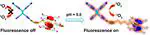
Molecular theranostic platforms with precise molecular structure and multiple functions hold great promise for cancer therapy. Different from the current strategy to incorporate various components into single entities with the risk of compromised efficacy and poor reproducibility, herein, molecular aggregation-induced emission (AIE) photosensitizers with ingenious integration of AIE fluorophore and cisplatin are facilely synthesized for synergetic anticancer therapy. Through adjusting donor structures coordinated with a cisplatin moiety and balancing the hydrophobic–hydrophilic property, donor–acceptor strength, and intramolecular charge transfer effect, the newly designed AIE photosensitizer TNPT exhibits good cellular uptake with predominant mitochondria location of cancerous cells, high chemotherapeutic efficacy similar to that of cisplatin, and strong reactive oxygen species (ROS) generation capability better than that of chlorin e6 (Ce6). Importantly, TNPT demonstrates synergetic photodynamic and chemotherapy on C6 glioma cells, showing 2.4-fold more potency than cisplatin upon white light irradiation (15 J/cm2). Further cell cycle analysis and apoptosis assay indicate that the photodynamic and chemo-therapeutic functions of TNPT synergistically inhibit DNA replication and cause cell apoptosis. In addition, TNPT exhibits selective uptake on cancerous cells rather than normal cells, contributing to significantly lower cytotoxicity to normal cells as compared to free cisplatin. This study provides a facile strategy to design molecular theranostic agents.
All-in-One Molecular Aggregation-Induced Emission Theranostics: Fluorescence Image Guided and Mitochondria Targeted Chemo- and Photodynamic Cancer Cell Ablation
All-in-One Molecular AIE Theranostics: Fluorescence Image Guidedand Mitochondria Targeted Chemo- and Photodynamic Cancer CellAblation
Molecular theranostic platforms with precise molecular structure and multiple functions hold great promise for cancer therapy. Different from current strategy to incorporate various components into single entities with the risk of compromised efficacy and poor reproducibility, herein, molecular aggregation-induced-emission (AIE) photosensitizers with ingenious integration of AIE fluorophore and cisplatin are facilely synthesized for synergetic anticancer therapy. Through adjusting donor structures coordinated with cisplatin moiety and balancing the hydrophobic-hydrophilic prop-erty, donor-acceptor strength, and intramolecular charge transfer effect, the newly designed AIE photosensitizer TNPT exhibits good cellular uptake with predominant mitochondria location of cancerous cells, high chemotherapeutic efficacy similar to cisplatin, and strong reactive oxygen species (ROS) generation capability better than chlorin e6 (Ce6). Im-portantly, TNPT demonstrates synergetic photodynamic and chemo-therapy on C6 glioma cells, showing 2.4-fold more potent than cisplatin upon white light irradiation (15 J/cm2). Further cell cycle analysis and apoptosis assay indicate that the photodynamic and chemo-therapeutic functions of TNPT synergistically inhibit DNA replication and cause cell apop-tosis. In addition, TNPT exhibits selective uptake on cancerous cells rather than normal cells, contributing to significantly lower cytotoxicity to normal cells as compared to free cisplatin. This study provides a facile strategy to design molecular theranostic agents.
All-in-One Molecular AIE Theranostics: Fluorescence Image Guidedand Mitochondria Targeted Chemo- and Photodynamic Cancer CellAblation
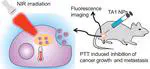
Nanostructural Control Enables Optimized Photoacoustic–Fluorescence–Magnetic Resonance Multimodal Imaging and Photothermal Therapy of Brain Tumor
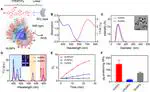
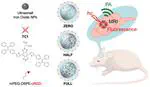
The performance of current multimodal imaging contrast agents is often constrained by the tunability of nanomaterial structural design. Herein, the influence of nanostructure on the overall imaging performance of a composite nanomaterial for multimodal imaging of brain tumors is studied. Newly designed near-infrared molecules (TC1) are encapsulated into nanocomposites with ultrasmall iron oxide nanoparticles (UIONPs), forming stable nanoagents for multimodal imaging and photothermal therapy (PTT). Through a modified nanoprecipitation method, the synthesis of nanocomposites denoted as HALF is realized, in which UIONPs are restricted to half of the nanosphere. Such a unique nanostructure that physically separates TC1 and UIONPs is found with capabilities of mitigating fluorescence quenching, preserving the good performance of photoacoustic imaging, and enhancing the magnetic resonance imaging signals. Decorated with a peptide ligand cRGD for better brain tumor targeting, HALF-cRGD is evaluated both in vitro and in vivo as imaging contrast agents and photothermal therapeutic agents. The good imaging performance and PTT effect of HALF-cRGD in mice models indicate that the rational design and control of nanostructures could optimize multimodal imaging performance using the same components.
Nanostructural Control Enables Optimized Photoacoustic–Fluorescence–Magnetic Resonance Multimodal Imaging and Photothermal Therapy of Brain Tumor