Article-Journal

Light-responsive AIE nanoparticles with cytosolic drug release to overcome drug resistance in cancer cells
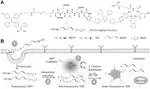
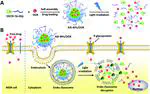
The acquisition of resistance to chemotherapy is a major hurdle for successful cancer therapy. Herein, a new light-responsive drug delivery nanoparticle system is developed to overcome doxorubicin (DOX) resistance in breast cancer cells. The nanoparticles with high drug loading capacity are self-assembled from an amphiphilic polymer which is composed of a hydrophobic photosensitizer (PS) with aggregation-induced emission (AIE) characteristics and a biocompatible and hydrophilic poly(ethylene glycol) (PEG) conjugated via a reactive oxygen species (ROS) cleavable thioketal (TK) linker. The AIE PS makes the nanoparticles visible for high-quality imaging and capable of generating ROS upon light irradiation. When exposed to white light irradiation, the ROS generated from the PS could not only induce the endo-lysosomal membrane rupture, but also break the nanoparticles. This results in facilitated endo-lysosomal escape and triggered cytosol release of DOX, which can significantly improve intracellular DOX accumulation and retention in drug resistant MDA-MB-231 breast cancer cells. With light irradiation, the drug loaded nanoparticles can significantly inhibit the growth of DOX-resistant MDA-MB-231 cells. These results reveal that AIEgen based nanoparticles offer a potentially effective approach to overcome drug resistance in cancer cells.
Light-responsive AIE nanoparticles with cytosolic drug release to overcome drug resistance in cancer cells
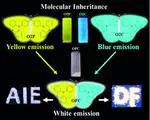
Silole-Based Red Fluorescent Organic Dots for Bright Two-Photon Fluorescence In vitro Cell and In vivo Blood Vessel Imaging
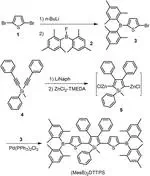
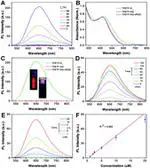
Robust luminescent dyes with efficient two-photon fluorescence are highly desirable for biological imaging applications, but those suitable for organic dots fabrication are still rare because of aggregation-caused quenching. In this work, a red fluorescent silole, 2,5-bis[5-(dimesitylboranyl)thiophen-2-yl]-1-methyl-1,3,4-triphenylsilole ((MesB)2DTTPS), is synthesized and characterized. (MesB)2DTTPS exhibits enhanced fluorescence efficiency in nanoaggregates, indicative of aggregation-enhanced emission (AEE). The organic dots fabricated by encapsulating (MesB)2DTTPS within lipid-PEG show red fluorescence peaking at 598 nm and a high fluorescence quantum yield of 32%. Upon excitation at 820 nm, the dots show a large two-photon absorption cross section of 3.43 × 10⁵ GM, which yields a two-photon action cross section of 1.09 × 10⁵ GM. These (MesB)2DTTPS dots show good biocompatibility and are successfully applied to one-photon and two-photon fluorescence imaging of MCF-7 cells and two-photon in vivo visualization of the blood vascular of mouse muscle in a high-contrast and noninvasive manner. Moreover, the 3D blood vasculature located at the mouse ear skin with a depth of over 100 μm can also be visualized clearly, providing the spatiotemporal information about the whole blood vascular network.
Silole-Based Red Fluorescent Organic Dots for Bright Two-Photon Fluorescence In vitro Cell and In vivo Blood Vessel Imaging
Dual-targeted activatable photosensitizers with aggregation-induced emission (AIE) characteristics for image-guided photodynamic cancer cell ablation
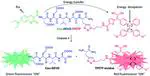
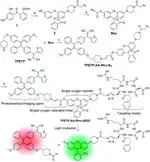
The currently available photosensitizers (PSs) for photodynamic therapy (PDT) can easily lead to undesirable normal cell death due to their intrinsic photo-toxicity and lack of selectivity for cancer cells. Activatable PSs with high therapeutic efficiency towards cancer cells but minimized side effects on normal cells are thus highly desirable. In this work, we developed a probe with dual-targeted activatable PSs that can recognize and ablate cancer cells with high selectivity. The probe is composed of a fluorophore with aggregation-induced emission (AIE) characteristics which can be used as an imaging agent as well as a PS, a quencher moiety that can be cleaved upon encountering biothiols, and a cyclic arginine–glycine–aspartic acid (cRGD) tripeptide for targeting cancer cells with overexpressed αvβ3 integrin. The probe itself is non-fluorescent and its ability to generate reactive oxygen species (ROS) is prohibited. However, it could be selectively activated to offer specific fluorescence turn-on with efficient ROS generation in the aggregated state, which was used to ablate cancer cells overexpressing both αvβ3 integrin receptors and glutathione. As compared to conventional activatable PSs which show quenched fluorescence and reduced ROS generation in the aggregated state, the dual-selection process with enhanced fluorescence and efficient ROS generation of the activated AIE probe in aggregated state offers a high signal-to-background ratio for MDA-MB-231 cancer cell imaging and ablation. This strategy thus opens up new opportunities for designing activatable PSs with high selectivity and low intrinsic photo-toxicity for photodynamic cancer cell ablation.
Dual-targeted activatable photosensitizers with aggregation-induced emission (AIE) characteristics for image-guided photodynamic cancer cell ablation
Tuning the singlet-triplet energy gap: a unique approach to efficient photosensitizers with aggregation-induced emission (AIE) characteristics
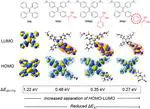
The efficiency of the intersystem crossing process can be improved by reducing the energy gap between the singlet and triplet excited states (ΔEST), which offers the opportunity to improve the yield of the triplet excited state. Herein, we demonstrate that modulation of the excited states is also an effective strategy to regulate the singlet oxygen generation of photosensitizers. Based on our previous studies that photosensitizers with aggregation-induced emission characteristics (AIE) showed enhanced fluorescence and efficient singlet oxygen production in the aggregated state, a series of AIE fluorogens such as TPDC, TPPDC and PPDC were synthesized, which showed ΔEST values of 0.48, 0.35 and 0.27 eV, respectively. A detailed study revealed that PPDC exhibited the highest singlet oxygen efficiency (0.89) as nanoaggregates, while TPDC exhibited the lowest efficiency (0.28), inversely correlated with their ΔEST values. Due to their similar optical properties, TPDC and PPDC were further encapsulated into nanoparticles (NPs). Subsequent surface modification with cell penetrating peptide (TAT) yielded TAT-TPDC NPs and TAT-PPDC NPs. As a result of the stronger singlet oxygen generation, TAT-PPDC NPs showed enhanced cancer cell ablation as compared to TAT-TPDC NPs. Fine-tuning of the singlet-triplet energy gap is thus proven to be an effective new strategy to generate efficient photosensitizers for photodynamic therapy.
Tuning the singlet-triplet energy gap: a unique approach to efficient photosensitizers with aggregation-induced emission (AIE) characteristics